
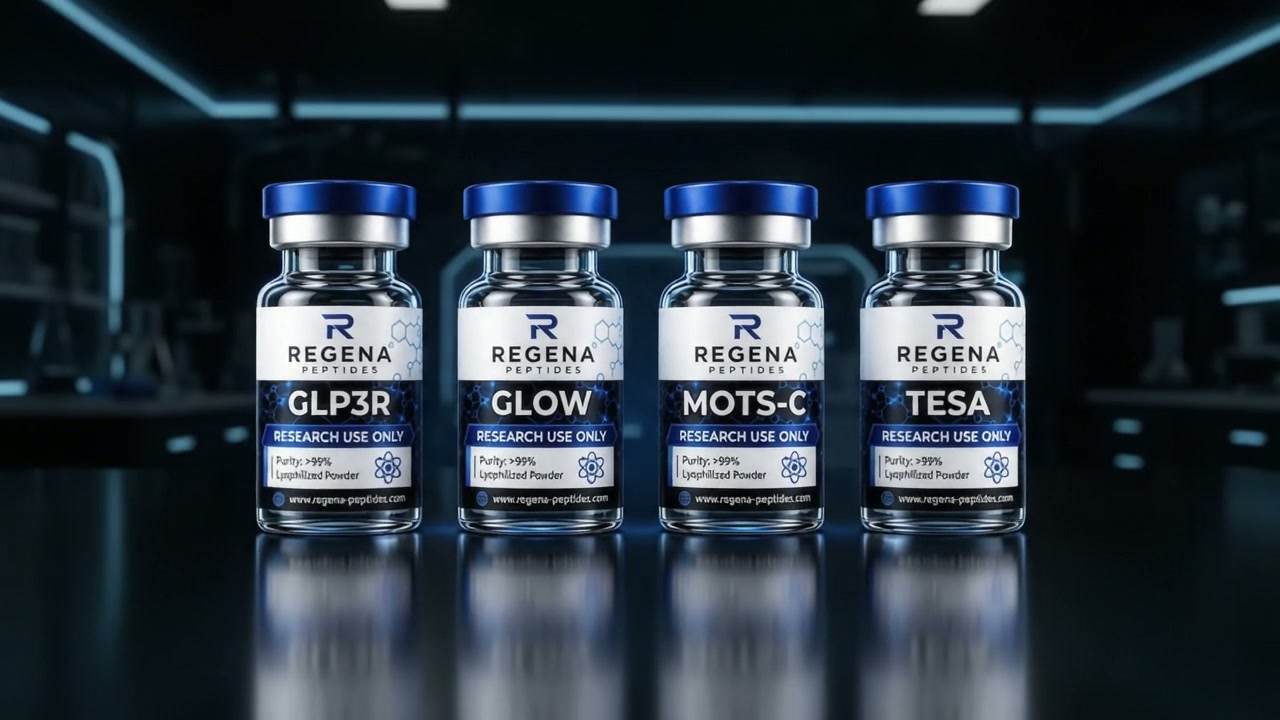
Melanocortin receptor comparison
PT-141 vs Melanotan II: Research Comparison | Regena
PT-141 (bremelanotide) and Melanotan II are both cyclic peptide agonists at the melanocortin receptors, but they were engineered for very different research applications. PT-141 is a selective MC3/MC4 agonist developed from Melanotan II specifically to remove the pigmentation-axis activity. Melanotan II is a broad-spectrum melanocortin agonist that engages MC1, MC3, MC4 and MC5. This page lays out the side-by-side detail.
Mechanism — how PT-141 and Melanotan II differ
PT-141 (bremelanotide) is a cyclic heptapeptide melanocortin agonist selective for MC3R and MC4R. The MC4R activation is the proposed mechanism for the CNS-mediated effects in published research; the MC1R activity that drives pigmentation is minimised by design.
Melanotan II is a cyclic heptapeptide agonist at MC1, MC3, MC4 and MC5. The broad receptor profile is the reason Melanotan II is used in pigmentation-axis research — MC1R activity drives the melanogenesis signal — but also the reason it produces the wider off-target profile PT-141 was engineered to avoid.
Receptor profile
PT-141 is selective for MC3R and MC4R — a narrow melanocortin research tool for isolating the MC4R-driven CNS-axis effects from the MC1R-driven pigmentation axis.
Melanotan II is a broad melanocortin agonist. It is the reference research tool for MC1R-mediated melanogenesis studies, but the broader receptor engagement produces a wider off-target profile in CNS, appetite and cardiovascular axes.
Pharmacokinetics and half-life
PT-141 has a short-to-medium research half-life; typical research cadences are per-experiment single-dose or intermittent rather than chronic. The cyclic structure improves stability over linear melanocortin peptides.
Melanotan II has a similar short half-life and cyclic-peptide stability profile. Research cadences vary widely depending on whether pigmentation-axis or acute CNS-axis endpoints are being measured.
Research applications
PT-141 is used in CNS melanocortin-axis research — particularly MC4R-driven signalling — where the pigmentation axis is a confound to be avoided. The receptor-selective profile makes it a cleaner research tool for isolating MC4R effects.
Melanotan II is used in pigmentation-axis research (MC1R melanogenesis), in broad melanocortin-axis studies, and as the reference broad-spectrum comparator when a wider receptor engagement is central to the experimental design.
Analytical specification on every Regena batch
Both PT-141 and Melanotan II ship from Regena only after independent third-party verification — Janoshik Analytical is the default verifier, with orthogonal independent laboratories used when batch chemistry calls for confirmation by a second method. Minimum release specification is ≥99.0% HPLC main-peak purity with matching mass-spectrometry molecular weight and water content within the published specification for the compound.
Batch COAs for both compounds are published on the Regena lab reports page so a research-peptide buyer can audit the analytical detail before purchase. The /trust/how-to-read-a-coa reference walks through every field on a modern Regena COA.
Handling, reconstitution and stability
Both compounds ship lyophilised under nitrogen. Hold the unopened vial at 2–8 °C; freeze at −20 °C for long-term storage. Reconstitution with bacteriostatic water (0.9% benzyl alcohol) supports a two-month (60-day) in-use stability window under refrigeration for both compounds.
Aliquot before any freeze. The single most common cause of measurable potency loss in research peptides is repeat freeze-thaw cycling — both PT-141 and Melanotan II benefit from single-thaw aliquot workflows. Vortex gently, never shake aggressively, and keep reconstituted vials away from direct light. The /research/compound-storage-guide reference covers the per-compound stability windows in detail.
When researchers choose PT-141 vs Melanotan II
Researchers choose PT-141 when the protocol requires MC3R / MC4R selective activation and needs to avoid MC1R pigmentation-axis confounds. Researchers choose Melanotan II when broad-spectrum melanocortin activation is the experimental requirement — pigmentation research, MC1R melanogenesis models, or when a broad melanocortin comparator arm is needed. Matched panels sometimes include both compounds to isolate the receptor-selectivity contribution.
For multi-compound comparator studies, the Regena consultations team will reserve matched-batch inventory of both PT-141 and Melanotan II against a project timeline so the experimental panel is sourced under a single analytical specification window.
Regulatory and research-use framing
Both PT-141 and Melanotan II are supplied strictly for in-vitro and preclinical research use. They are not medicines, are not approved for human consumption in Spain, the United Kingdom, the European Union or the United States, and are not dispensed against a prescription. The research-use declaration ships with every package alongside the independent third-party COA.
Comparison pages on the Regena site exist for laboratory-research reference. Nothing on this page constitutes a recommendation for human use of either compound.
Frequently asked questions
What is the main difference between PT-141 and Melanotan II?+
PT-141 (bremelanotide) is a cyclic heptapeptide melanocortin agonist selective for MC3R and MC4R.
Which has the longer half-life, PT-141 or Melanotan II?+
PT-141 has a short-to-medium research half-life; typical research cadences are per-experiment single-dose or intermittent rather than chronic. The cyclic structure improves stability over linear melanocortin peptides.
Are PT-141 and Melanotan II the same compound class?+
Both sit in the melanocortin receptor agonists category but with distinct receptor profiles and pharmacokinetics — see the receptor-profile section above for the side-by-side detail.
What HPLC purity does Regena release each compound against?+
≥99.0% HPLC main-peak purity for both PT-141 and Melanotan II, with matching mass-spectrometry molecular weight and water content within the published specification for each compound.
Who independently verifies the batches?+
Janoshik Analytical is the default independent verifier for both compounds; orthogonal independent laboratories are used when batch chemistry calls for second-method confirmation.
Can I order matched batches for a comparator study?+
Yes — the Regena consultations team will reserve matched-batch inventory of both compounds against a project timeline so the experimental panel is sourced under a single analytical specification window.
Are these peptides approved for human use?+
No. Both are supplied strictly for in-vitro and preclinical research use. They are not medicines, are not approved for human consumption, and are not dispensed against a prescription.
Where can I see the current batch COAs for both compounds?+
On the /coa lab reports page, indexed by compound and batch number. New batches appear within 24 hours of independent release.
Continue your research
Trusted reference supplier · Verified across review platforms
Trustpilot
4.8 / 5 · verified buyers
Google Reviews
Rated by Marbella clients
Scamadviser
Trust score verified
Verified Supplier
Peptides Lookup verified
SSL Secured
256-bit encrypted checkout
HPLC Verified
Batch COA on every vial
EU Sourced
Tested & shipped from EU
Discreet Delivery
Temperature-controlled
We accept · Multiple secure payment methods
- Bank transfer via Bunq
- Instant transfer